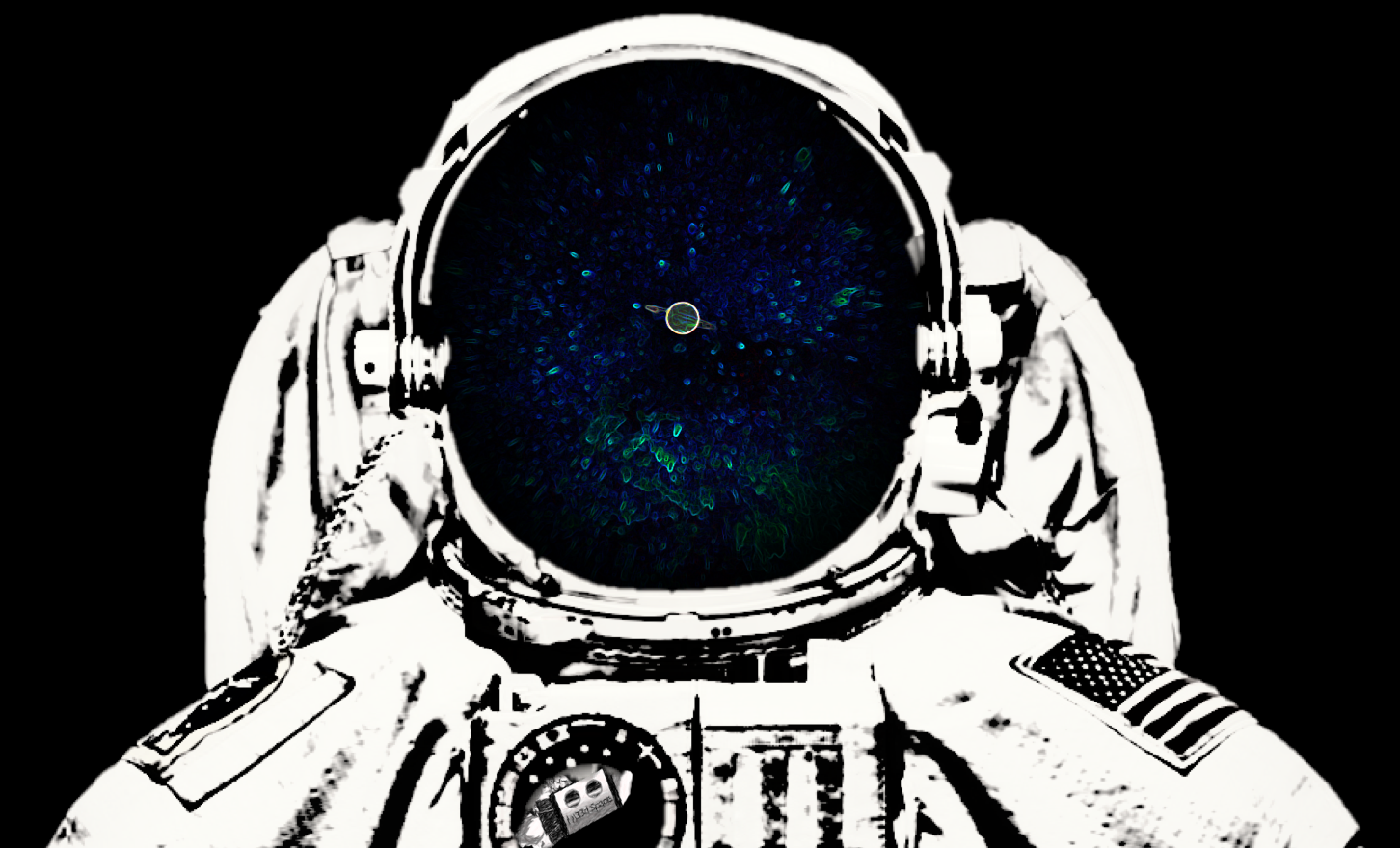
We live in a bubble! The size of our solar system is defined by the boundaries of the heliosphere. The heliosphere simply explained is a bubble–produced by the sun encasing the planets, asteroids, comets, meteorites, and all the “stuff” that comprises our solar system. In the Milky Way, our solar system is just one small part, located in one of the spiral arms towards the edge of the galaxy. That tiny bubble we live in protects us from things like intergalactic cosmic rays, interstellar gas and the mysteries of the interstellar medium (ISM). The ISM is just the space between stars, and it is right there on the outskirts of the heliosphere pushing up against its boundary.
Imagine traveling from Earth and reaching the edge of the heliosphere, and leaving our solar system forever. We have only ever gathered images of what lays beyond with space-based telescopes, like Hubble, Spitzer, and someday soon James Webb.
What about spacecrafts, satellites, or probes which ever word you prefer. The first man-made artificial satellite ever launched was Sputnik I by the Soviets in 1957, the United States soon followed with Explorer I in 1958. So we have been launching satellites since the late 50s. We (when I say we, I mean has a unified global effort) have launched probes to visit all the planets in the solar system.
In 1977, two spacecrafts were launched to study Saturn, Jupiter, Uranus, and Neptune. Voyager I and Voyager II made their maiden voyage and completed their primary mission, however, like many missions these two spacecrafts were still perfectly functioning scientific instruments, so their mission was extended to an intergalactic one. To this day the Voyager probes are still traveling and sending messages back to NASA.
In 2012, after 35 years of traveling Voyager I made history, by crossing over the boundary of the heliosphere, into the ISM, effectively leaving its home solar system behind forever. The very first man-made object to travel through interstellar space. Voyager II has crossed a part of the heliosphere known as the termination shock and is still on its way to the ISM. The two are traveling as though they came to a fork in the road and went their separate ways. the Jet Propulsion Laboratory (JPL) at NASA says that the Voyager twins will continue to send data back until about 2020, enhancing our understanding of the space between the Stars.
Even after the twin spacecrafts shut down and discontinue their “talk” with NASA, they will still be journeying on through the galaxy. So, what happens if a fellow spacefarer or extraterrestrial stumbles upon our beloved spacecrafts? Not to fret, in the case that Voyager I and/or II are intercepted, they have both been outfitted with a Golden Record (pictured below courtesy of JPL/NASA).
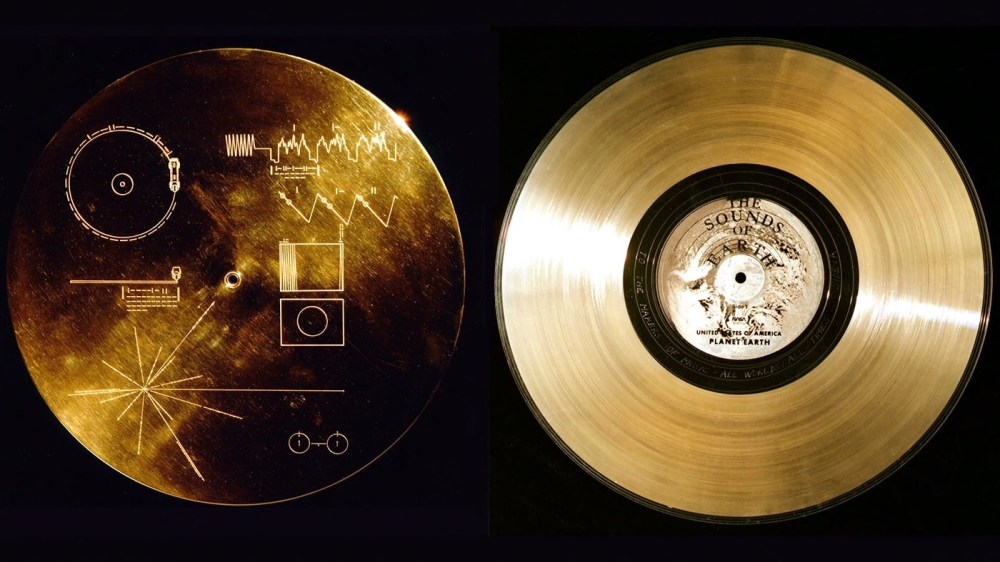 The Golden Record contains “The Sounds of Earth, which has everything from music, to audio clips, to sounds of animals. It also comes complete with instructions on how to play the record, and a “map” so-to-speak, of our location, which you can see in the image of the record’s cover.
In 1990, while Voyager I was making its way to Saturn it turned and aimed its camera back towards Earth and captured a photo of our home. The image of Earth is the furthest distance that had ever been viewed by its residents, and was dubbed “The Pale Blue Dot.”
Can you see where we are in the image below captured by Voyager I?
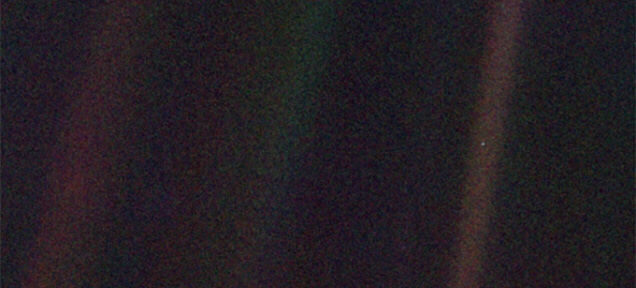
Image Credit: JPL/NASA
If you can’t quite find where you are this might help…
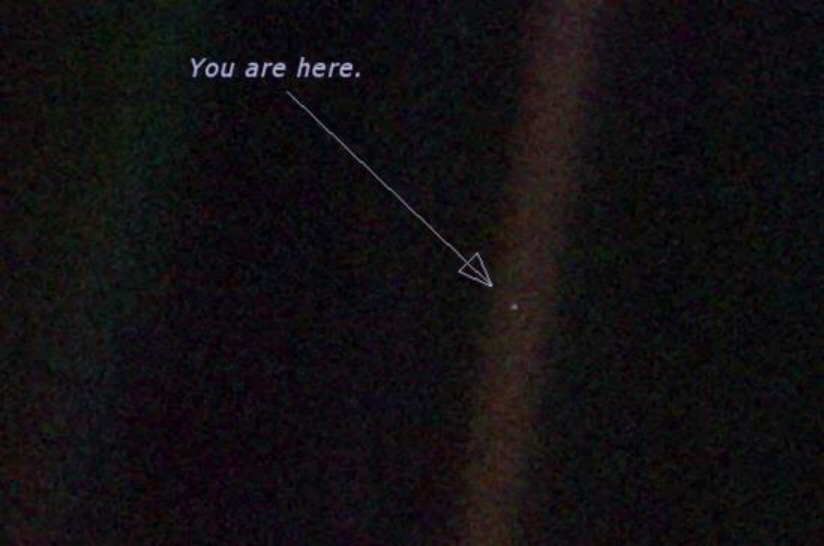
Image Credit: JPL/NASA
This puts so much perspective into how small we are in this universe, and this image is only taken about 6 billion kilometers away–inside an ever expanding universe. As we close, think about our tiny position in this universe and consider this passage from Carl Sagan on our Pale Blue Dot.
“From this distant vantage point, the Earth might not seem of any particular interest. But for us, it’s different. Consider again that dot. That’s here. That’s home. That’s us. On it everyone you love, everyone you know, everyone you ever heard of, every human being who ever was, lived out their lives. The aggregate of our joy and suffering, thousands of confident religions, ideologies, and economic doctrines, every hunter and forager, every hero and coward, every creator and destroyer of civilisation, every king and peasant, every young couple in love, every mother and father, hopeful child, inventor and explorer, every teacher of morals, every corrupt politician, every “superstar,” every “supreme leader,” every saint and sinner in the history of our species lived there — on a mote of dust suspended in a sunbeam.
The Earth is a very small stage in a vast cosmic arena. Think of the rivers of blood spilled by all those generals and emperors so that in glory and triumph they could become the momentary masters of a fraction of a dot. Think of the endless cruelties visited by the inhabitants of one corner of this pixel on the scarcely distinguishable inhabitants of some other corner. How frequent their misunderstandings, how eager they are to kill one another, how fervent their hatreds. Our posturings, our imagined self-importance, the delusion that we have some privileged position in the universe, are challenged by this point of pale light. Our planet is a lonely speck in the great enveloping cosmic dark. In our obscurity — in all this vastness — there is no hint that help will come from elsewhere to save us from ourselves.
The Earth is the only world known, so far, to harbour life. There is nowhere else, at least in the near future, to which our species could migrate. Visit, yes. Settle, not yet. Like it or not, for the moment, the Earth is where we make our stand. It has been said that astronomy is a humbling and character-building experience. There is perhaps no better demonstration of the folly of human conceits than this distant image of our tiny world. To me, it underscores our responsibility to deal more kindly with one another and to preserve and cherish the pale blue dot, the only home we’ve ever known”
-Carl Sagan


I did not know there was craft floating out there away from Earth. Voyager 1 and 2. Very interesting
LikeLike
I would love to learn about the possibilities of life on other planets simply based on how massive the universe is. anything you can write on the massiveness of this universe? galaxy?
LikeLiked by 2 people
This is a great topic to write about it, and TBQF the topics to write on are as infinitely large as the universe itself. One key to finding life in the universe is the presence of water, which is why when NASA finds ice, its a big deal. I plan on posting two articles that will lend itself to your interests, one is the James Webb Telescope, which will will be dedicated to this mission, when its launched in 2020. One mission focus of JWT is the TRAPPIST-1 system, which has about 7 Earth-like planets orbiting their own star. Another interesting post, which is semi-science fiction, but also, okay how do we this, is the idea of Terra-forming another planet. Also, understanding how we survive on Earth with the rash attitude and solar-fits of the Sun, is an important key to finding life, around other stars. Look out for these posts and thank you for your interest, fellow spacefarer!
LikeLiked by 1 person
Thanks for article i like it alot keep up good work:)
LikeLike