Three years ago, on July 14th 2015, the New Horizons spacecraft made its closest approach to Pluto. A planet that had been so far from us that views of it were previously hazy, and most knowledge about it was theories and guesses. Scientists had been back and forth on whether Pluto was bigger than its moon Charon, or if maybe Charon was bigger than it. A unique feature to these two is that they are a binary planet system–which is common with stars, but that’s a story for another day.
You may be thinking, what is a binary planet system? Well, I’m glad you asked. Look at the Moon, or think about the Moon and its orbital motion around Earth. The Moon is tidally locked to Earth, meaning we only ever see the one face as the Moon sweeps around us, and as the Moon does its thing around Earth, the gravitational force of the Moon is not strong enough to keep Earth spinning or causing anything stronger than create large waves in the ocean, or give Earth a little wobble on its axis. The point is they both kind of do their own thing, yet Earth has a strong effect on the Moon by tidally locking it.
Pluto and Charon however, don’t really have power over the other. Neither orbits the other,instead they orbit about a point between them. If you were on Charon facing Pluto you would always see the same face, and if you were on Pluto facing Charon, you also would always see the same face. They are locked with each spinning about the point between them. It would take a long time and cost a lot of money but because of their orientation you could build a bridge connecting them.

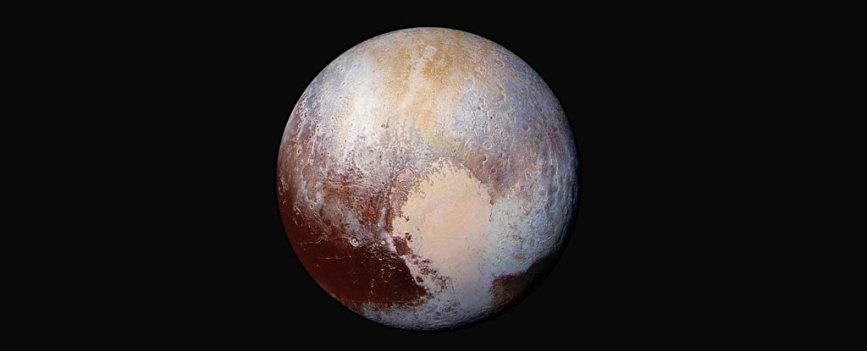
I’ll never forget where I was when New Horizons made its first reveal of the “real” Pluto, it was one of the most memorable nights of my life. I say the “real” Pluto because as you can see from the image above, it does not tells us much. The images New Horizons sent backed showed a dynamic world, with theories of a possible subsurface ocean, a blue atmosphere, and the largest glacier in the solar system. To name a few discoveries, I won’t get into to the details of the escaping atmosphere and other nerdy science discoveries this time around. I will say that after Pluto was demoted to a dwarf planet–with good reason, more to follow in So, What is a Planet Anyway?–people felt cheated, wronged, and they even spoke out with protests and “Make Pluto a Planet Again” marches. Somehow the population has a sentimental attachment to Pluto, a small planet deep in the solar system, that had been nothing but a hazy image all these years, and somehow people just love it.

So, the fun part of the New Horizons two-decade long mission planning and almost nine years of space travel, it revealed that Pluto literally has love right on the surface, in the form of its heart-shaped glacier. That can only mean one thing, Pluto loves us back! The details in the image below compared to the hazy view we had all those years, is absolutely stunning.
New Horizons had such a successful mission, that its mission was extended. Now we get to wait on the edge of our seats until 1 January 2019 as New Horizons makes its closest approach to 2014 MU69. I know, fancy name right? This is a Trans-Neptunian, Kuiper Belt Object, which is believed to house information to the origins of our Solar System. The Kuiper Belt is fairly new territory for us to explore having only been confirmed about three decades ago. So, mark your calendars and get ready for some new discoveries.
Featured image of this article is an artistic rendering courtesy of NASA.

 I Need Space